No-BS Yamaha HS8 Review: Studio Monitors in the Lounge Room
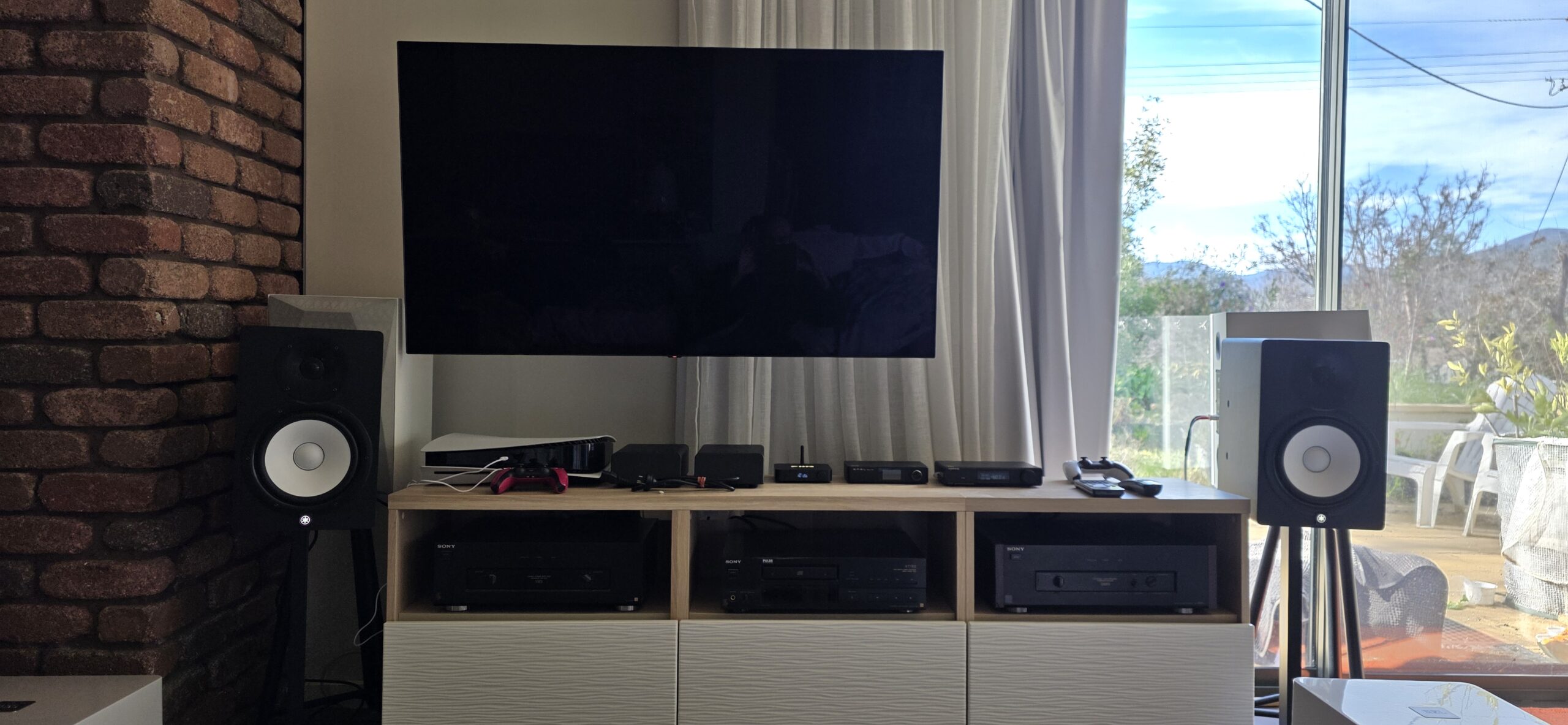
Yamaha HS8 in the lounge room
A No-BS Yamaha HS8 Review: Studio Monitors in the Lounge Room
The time has come! — They said. Who are they? They are the Yamaha HS8 powered studio monitors. But they are more — more than just studio monitors! This is a review of my own personal pair. They spent years as my desktop work speakers — on stands, 1.5 metres either side of centre, about 3 metres apart — so I know their near-field manners very well. Then I wanted to see if they’d also work for home theatre, so they moved to the lounge room at 2.8 metres, a fair way outside their design brief. Spoiler: they held up. Give me ten minutes and you’ll get the no-BS version — the good, the measured, and the bits Yamaha’s brochure skips.
Who are they for?
- Music and visual creators who need to hear their source material accurately in the near field. This is the job they were built for, and they’ve been doing it in studios all over the world for over a decade.
- Small-room AV setups running 2.0, or 2.1 with a sub crossed over at around 80 Hz — which shifts the hardest work away from the woofer and into a box designed for it. More on why the measurements agree with this later.
- Anyone who wants proper sound without buying an amplifier. The amps are in the box. Plug them into your preamp and you’re done.
A good friend of mine has been mixing on Yamaha monitors for years, working his way through the previous generations to arrive at the HS8s — they’ve helped write dance tracks, edit songs for performers, and generally manipulate sound for the world to enjoy. That pedigree is real. The question this review answers is what happens when you take them out of the studio and put them in front of a couch.
How they sound
Tonally rich and accurate, with clean, well-defined mids handing over smoothly to the tweeter at the 2 kHz crossover. Now, I was tempted to write “zero colouration” here, but the measurements would tattle on me: ASR’s Klippel data shows a frequency deviation of about 2.3 dB through the midrange and a tonality preference score of 5.7 — rising to 7.4 with a proper subwoofer. Translation: impressively neutral for the money, with no dips or peaks big enough to meaningfully colour the sound, and a main “flaw” that mostly amounts to politely asking for help below 80 Hz.
On bass: Yamaha quotes 38 Hz–30 kHz, but that’s the −10 dB figure — the more useful −3 dB point lands around 44 Hz. For an 8-inch two-way, that’s honest, usable bass. There’s a rear-firing port, so pull them off the back wall and the low end is impactful even at moderate volumes; shove them against the plaster and the room will add bass you didn’t order.
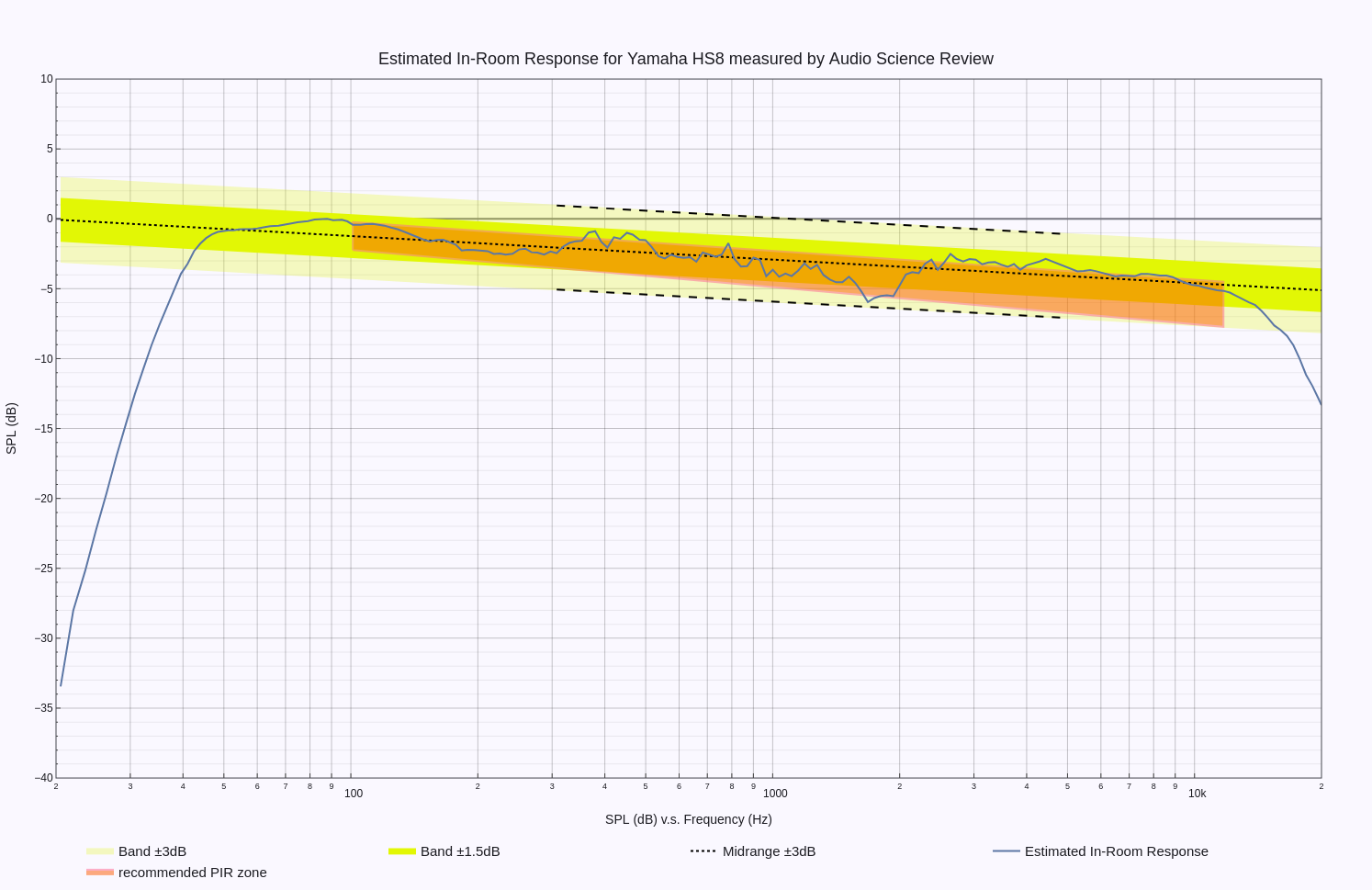
Yamaha HS8 in room response.
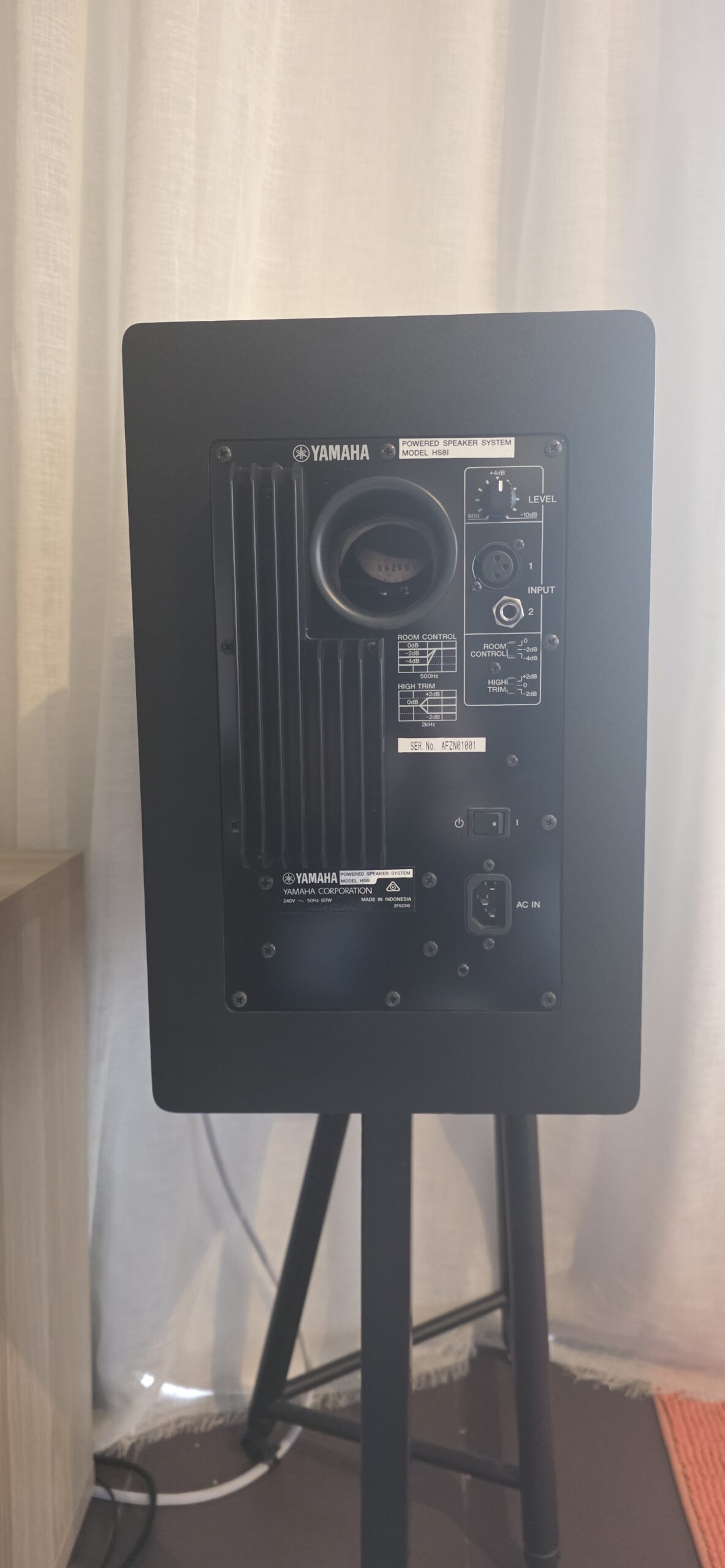
Yamaha HS8 rear Panel
Free amplification (and free silence)
The major drawcard: built-in Class AB bi-amplification — a dedicated 75 W amp on the woofer and 45 W on the tweeter, 120 W total per speaker. That’s watts, not decibels, but trust me, it’s enough to reach volumes that are genuinely uncomfortable in a lounge room. No amplifier shopping, no cable-matching rabbit holes, no wondering if your amp is “enough.”
The rear level knob isn’t a volume control so much as a gain-staging control — it sets input sensitivity, with a centre detent at +4 dB. Set both speakers to the detent (the click makes matching left and right foolproof, handy when the knobs face the wall) and do your volume from the preamp. The classic mistake is running your source output low and cranking the speakers to compensate, which wrecks the punch. Don’t do it!
Inputs are balanced XLR and TRS. Use balanced cables from your preamp if it has balanced outputs — balanced connections reject induced noise and are far less prone to the ground-loop hum that plagues unbalanced RCA, which has no such rejection to offer. Two honest caveats: the benefit only exists if your source is actually balanced (an RCA-to-TS adapter makes the whole run unbalanced, socket shape notwithstanding), and balanced reduces ground-loop susceptibility rather than abolishing it — a badly wired system can still hum. Mine doesn’t: from my seat at 2.8 metres the HS8s are silent, and with my ear pressed against the tweeter there’s only the faintest hiss. Yamaha publishes no self-noise spec, so take that as one owner’s ears — but they’re good ears, and it’s a quiet speaker.
Setup in my lounge — the part nobody else tests
Yamaha designed these to sit an arm’s length from a mixing engineer — and for years mine did exactly that, flanking my work desk in a studio of sorts. The lounge setup started as a test to see whether they’d suit home theatre duty. It does. At 2.8 metres, here’s what actually matters:
Tweeters at ear height. Non-negotiable. Whether it’s floor stands or a shelf, get the tweeter aligned with your seated ear height — the 8-inch woofer makes these taller boxes than you expect, so measure before you buy stands.
Toe-in. Mine are angled so each axis lands around shoulder height and width at the listening position — slightly off-axis by design, which softens the very top end and widens the sweet spot for a couch rather than a single mixing chair. The ASR thread suggests crossing the axes in front of the seat to tame the treble; my setup gets there by a slightly different route, and I’ve never once sat there thinking “I wish these sounded more like speaker X.” Left, right, centre — placement is wide and accurate, and the soundstage actually sounds wider than the speakers physically sit. Close your eyes and the room grows.
Room Control and High Trim. Two switches on the back: Room Control shelves the output below 500 Hz by 0/−2/−4 dB, and High Trim swings the highs ±2 dB. Call it analogue DSP — two switches doing the job room-correction software charges a subscription for. If the speakers must live near a wall, flick Room Control to −2 dB and thank Yamaha later. Fair’s fair though: these are broad tone controls, not surgery. If you need to target a specific frequency, that’s a job for actual EQ upstream, not a switch on the back. For what it’s worth, I tested with everything flat and no EQ anywhere in the chain — and didn’t feel the need to tweak a thing. Maybe I’m getting old, but the experience was more than adequate for what these speakers are.
My room helps, and yours might too. ASR’s measurements flag rough vertical directivity — common in non-coaxial designs — which reaches your ears via floor and ceiling reflections. My lounge has carpet (absorbing the floor bounce) and 3-metre ceilings (so the ceiling reflection arrives later and weaker than in a standard room), with tweeters at ear height keeping the direct sound clean. Result: the measured weakness never materialised as an audible one here. In a bare, low-ceilinged room, your mileage may vary — that’s not me dodging the data, that’s the data meeting a real room.
Home theatre duty
As a 2.0 pair straight off a preamp for TV and film, they’re superb — dialogue clarity is exactly what you’d hope from a speaker built so engineers can hear every mistake, and with two real boxes delivering real stereo separation, it’s a genuine step up from any soundbar at the price. Add a sub crossed at ~80 Hz and it gets better still, and here the measurements genuinely back the advice: ASR’s review found distortion is well-controlled at 86 dB SPL but climbs to unacceptable levels by 96, with much of the misbehaviour between 200–500 Hz traced to the port. An 80 Hz high-pass offloads the woofer’s hardest work — though it won’t fix a resonant hump near 300 Hz, so a sub solves most of it, not all of it.
My own listening sweet spot landed at 86–96 dB at the seat before I’d read any of that — which means my ears and a Klippel scanner independently drew the same line. I’ll take it. Keep them in that window and they stay clean and composed; chase their limits and they’ll let you know, loudly and grittily, that you’ve overstayed.
Where they fall short
No speaker at this price escapes compromise, so being completely transparent: the vertical off-axis response is rough (manageable with room and placement, as above). There’s that port-related resonance around 300 Hz that no crossover setting removes. There’s no actual DSP or room correction — the switches are charmingly analogue, which cuts both ways. They’re big and heavy at 10.2 kg each, so flimsy shelves need not apply. The rear port demands breathing room from the wall. And they’re a black MDF box with a white cone — more on that in a moment.
Specs at a glance
| Spec | Yamaha HS8 |
|---|---|
| Type | 2-way bi-amped powered monitor, bass reflex (rear port) |
| Drivers | 8″ cone woofer, 1″ dome tweeter |
| Frequency range | 38 Hz–30 kHz (−10 dB); ~44 Hz (−3 dB, measured) |
| Crossover | 2 kHz |
| Amplification | 120 W Class AB bi-amp (LF 75 W / HF 45 W) |
| Controls | Level (+4 dB centre detent), High Trim (±2 dB HF), Room Control (0/−2/−4 dB below 500 Hz) |
| Inputs | Balanced XLR and TRS |
| Dimensions | 250 × 390 × 334 mm |
| Weight | 10.2 kg |
Full specifications on Yamaha’s product page; independent measurements at spinorama.org and the full Audio Science Review measurement review.
Verdict
Measurements tell you what a speaker does; they don’t tell you whether you’ll enjoy it from your couch. A preference score of 5.7 that jumps to 7.4 with a sub describes a speaker whose main sin is asking for help below 80 Hz — and around A$850 a pair locally (against a US price that converts to well north of A$1,200), the HS8s arrive with their own amplifiers, balanced inputs, room-tailoring switches and a sound that measurement rigs and my lounge room both approve of.
Are they pretty? They look like studio monitors because they are studio monitors — the little black dress of pro audio. Some will love the styling; it says “studio,” which conveniently also says “I know what I’m doing” in a lounge or spare room. But you’re not buying them for the paint. You’re buying them for what comes out of the front. It’s far from a perfect speaker — but at the price, used correctly, it will deliver much joy.
FAQ
Are the Yamaha HS8s good for home theatre? Yes — as a 2.0 pair off a preamp they deliver excellent dialogue clarity, and as a 2.1 with a sub crossed at ~80 Hz they’re better still, since the crossover offloads the frequencies where the HS8 distorts first.
Do the HS8s need a subwoofer? Need? No — usable bass extends to roughly 44 Hz. Benefit? Absolutely: measurements show the tonality score jumps from 5.7 to 7.4 with a proper sub handling the low end.
How loud can the HS8s go? Louder than is sensible in a lounge room, but keep them under roughly 96 dB at the listening position — measured distortion is well-controlled at 86 dB and unacceptable by 96, which matches my own listening sweet spot of 86–96 dB.
Are the Yamaha HS8s audiophile grade? Depends on the type of audiophile. If yours values measured neutrality, honest engineering and hearing the recording as it was made, the HS8 is more “audiophile” than plenty of boxes costing three times as much. If yours values exotic veneers, brand cachet and a warm story about cables — no, and they never wanted to be.
Wondering what to pair the Yamha HS8’s with? A simple 1 box solution can be the SMSL SU9n, it’s a DAC + Preamp with XLR outputs and a remote, has a toslink & coax inputs to accommodate a TV, CD and more … read the full review over on the SU9n page linked above.
Outro
If you’re into HiFi, looking to setup or install a system you can reach out to me for a chat. vAudio Architect specialize in custom installation services and supply of HiFi/ Audio Video for both domestic and commercial use.
Have a special project you’d like us to consult on? I’d love to hear more about it.
Or just ask if we have any review stock to be cleared.
Reach out using the contact form below or call the 1800 number.
Happy sound hunting!
“”Cheers
G
Would you like to talk about your next project?
More Articles: